
tagged by: experience reports
The LMAX Architecture
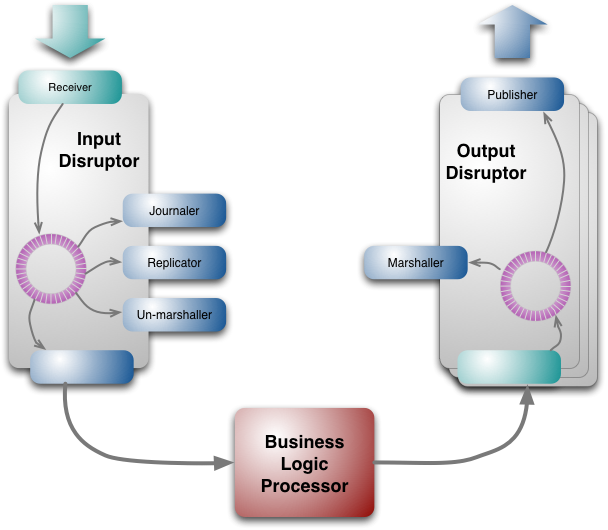
LMAX is a new retail financial trading platform. As a result it has to process many trades with low latency. The system is built on the JVM platform and centers on a Business Logic Processor that can handle 6 million orders per second on a single thread. The Business Logic Processor runs entirely in-memory using event sourcing. The Business Logic Processor is surrounded by Disruptors - a concurrency component that implements a network of queues that operate without needing locks. During the design process the team concluded that recent directions in high-performance concurrency models using queues are fundamentally at odds with modern CPU design.
Building Reliable Agentic AI Systems
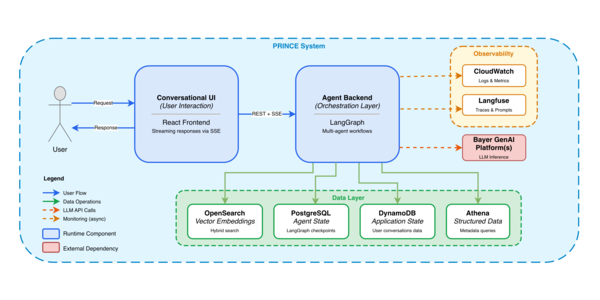
This paper presents the Preclinical Information Center (PRINCE), a cloud-hosted platform developed by Bayer AG with Thoughtworks to address pharmaceutical industry challenges in drug development. PRINCE leverages Agentic Retrieval-Augmented Generation and Text-to-SQL to integrate decades of safety study reports. We describe PRINCE's evolution from keyword-based search to an intelligent research assistant capable of answering complex questions and drafting regulatory documents. We reflect on key engineering decisions through the lens of context engineering—how information was shaped and routed between specialized agents—and harness engineering—how orchestration, recovery, and observability were built around the models to maintain control and reliability. The system prioritizes trust through transparency, explainability, and human-in-the-loop integration. PRINCE demonstrates AI's transformative potential in pharmaceuticals, significantly improving data accessibility and research efficiency while ensuring governance and compliance.
Decentralizing the Practice of Architecture at Xapo Bank
Xapo was founded as a Bitcoin service provider and developed into an online bank. During this transition it needed to reassess its software estate and establish an architecture capability to guide its future. It took on ideas from Domain-Driven Design, Team Topologies, and the Architecture Advice Process to develop an Architectural Advice Forum. This led to greater alignment of its software delivery teams, and a coherent technology strategy.
Democratic Political Technology Revolution
My colleague Zack Exley and I talk about the software that was used by the 2008 Obama presidential campaign. An aspect I found particularly interesting was the way in which the software enabled and interacted with the organizational approach to the campaign.
Software and Obama's Victory
Barack Obama's victory in the 2008 Presidential campaign included a significant contribution from software - particularly using the Internet. But perhaps the most interesting aspect was the interplay between advances in software and developments in the human organization of the campaign.
The Architecture of Gap Inc's SCMS
SCMS PO is an application that helps Gap Inc. manage purchase orders. The architecture of the application is well liked by its development team and thus makes a good expositional architecture for a system with a rich javascript front end working with a back-end serving json. Interesting design features include using knockout.js form of the Presentation Model pattern, a javascript validator running on both client and server, encapsulating data access with repositories, using MongoDB as an application database, and the testing portfolio.
The Architecture of the Morrison's OrderPad
Morrisons OrderPad is a tablet web-application that helps staff in supermarkets place orders for new stock as they walk around the store. The resulting application makes a good expositional architecture for a tablet web application backed by a lightweight java server application. We highlight the separation of application control and DOM interaction on the client, using small, focused frameworks on the server, the broad-stack testing environment, and the use of a pilot project to understand what features were needed.
C3
C3 was the short name of the Chrysler Comprehensive Compensation project, a payroll project at Chrysler which has since become famous as the 'birth project' of Extreme Programming.
Nashville Project
I spent some time recently with one of my favorite ever Thoughtworks projects. It's a project that started in 1998, using then new J2EE technology. Over the years it's had a fascinating history: starting with EJBs, ripping them out, going offshore to Bangalore, coming back to Chicago. Many people have moved in and out of the project and the project has varied in head-count between 6 and 60. Overall the project has had over 300 staff-years of effort on it and weighs in at around 100 KLOC.
Roller Skate Implementation
A key property of agile development is figuring out how to make a system go live with a small subset of features. We build software for the business value it offers, the quicker we go live, the faster we get at least some of that business value.